
By Dixit & Associates, Chartered Accountants
Nepalgunj, Nepal | www.danepal.com
Introduction
In a dynamic financial environment where stakeholders demand accountability and transparency, the auditor’s opinion serves as the ultimate seal of credibility. It communicates whether an entity’s financial statements present a true and fair view, in accordance with the Nepal Financial Reporting Standards (NFRS) and the Nepal Standards on Auditing (NSA) which are harmonized with the International Standards on Auditing (ISA). An audit opinion is not merely a formality; it is an independent professional judgment that influences investment decisions, regulatory trust, and public confidence.
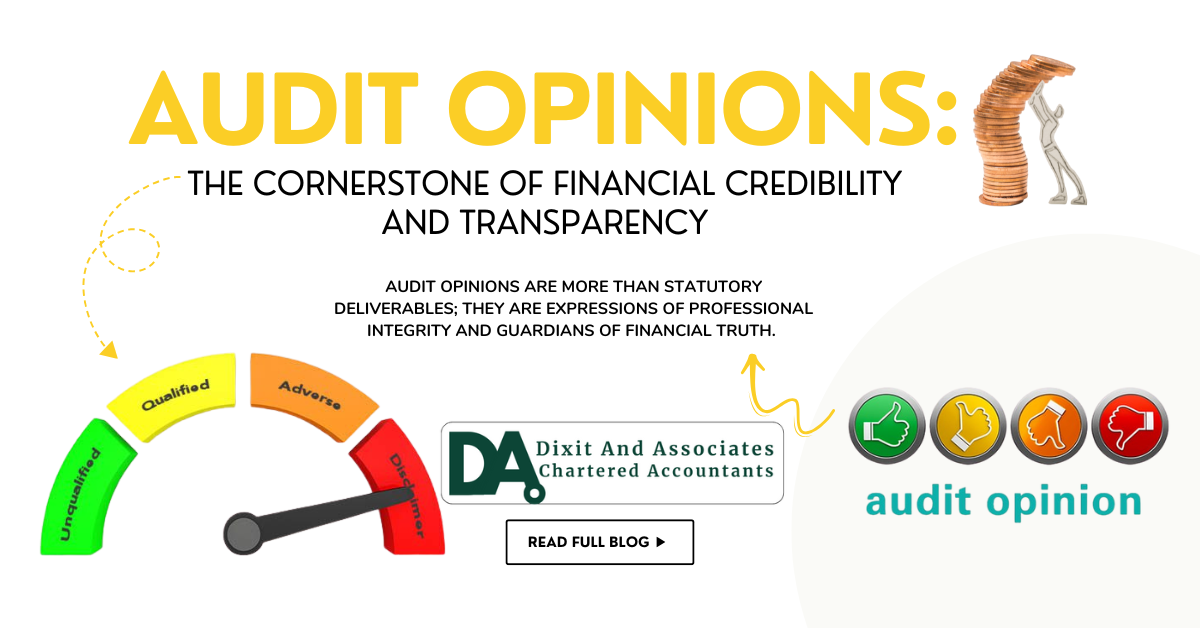
The Four Types of Audit Opinions
Auditors express one of four opinions based on the nature, materiality, and pervasiveness of misstatements or limitations encountered during the audit process:
- Unmodified (Clean) Opinion
- Qualified Opinion
- Adverse Opinion
- Disclaimer of Opinion
Each opinion carries a distinct professional implication and requires precise articulation backed by evidence and judgment.
1. Unmodified (Clean) Opinion: An unmodified opinion signifies that the auditor has obtained sufficient and appropriate evidence to conclude that the financial statements are free from material misstatement, whether due to fraud or error.
Implications
- Financial statements comply with NFRS and statutory requirements.
- Adequate disclosures and consistent accounting policies have been applied.
- Stakeholders can rely on the financial information with a high degree of confidence.
Illustrative Case
A company maintains comprehensive records, transparent disclosures, and effective internal controls. The audit reveals no material misstatement. → Opinion: Unmodified (Clean)
Professional Observation
An unmodified opinion reflects sound governance, disciplined accounting practices, and management integrity — reinforcing investor trust and institutional reputation.
2. Qualified Opinion: A qualified opinion is expressed when the auditor concludes that a material misstatement exists in the financial statements or that audit scope was limited in a specific area but the effect is not pervasive to the financial statements as a whole. The report typically includes the phrase “except for the matter described…”.
Common Triggers
- Non-verification of inventory or fixed assets.
- Non-disclosure of related party transactions.
- Incomplete confirmations of receivables or payables.
Illustrative Case
A trading company was unable to perform physical verification of its inventory due to logistical constraints. All other records and disclosures were satisfactory. → Opinion: Qualified due to limitation in scope.
Professional Observation
A qualified opinion denotes isolated compliance deficiencies that management can address through corrective measures. It reflects transparency and accountability rather than systemic failure.
3. Adverse Opinion: An adverse opinion is issued when the auditor determines that misstatements are both material and pervasive, resulting in financial statements that do not present a true and fair view.
Common Triggers
- Recognition of fictitious revenue.
- Omission of material liabilities or contingent exposures.
- Fundamental departures from NFRS in multiple areas.
Illustrative Case
A construction company records incomplete projects as revenue and conceals payables to subcontractors. Such treatment materially distorts profitability and the financial position.
→ Opinion: Adverse.
Professional Observation
An adverse opinion signifies a serious breakdown in financial integrity and governance, warranting regulatory scrutiny and immediate corrective action by management and the board.
4. Disclaimer of Opinion: A disclaimer of opinion is issued when auditors are unable to obtain sufficient appropriate audit evidence, and the potential effects of undetected misstatements could be both material and pervasive. In such cases, the auditor does not express an opinion.
Common Triggers
- Management denies access to accounting records or explanations.
- Loss or destruction of key documentation.
- Unresolved uncertainty regarding going concern or litigation.
Illustrative Case
A cooperative society fails to maintain proper books of account and restricts auditor access to supporting documentation. → Opinion: Disclaimer of opinion.
Professional Observation
A disclaimer reflects severe information deficiency and an absence of audit assurance. It signals governance failure and often attracts attention from regulators and financing institutions.
Detailed Matrix of Situations and Audit Opinions
| Sr. No. | Situation / Case | Nature of Issue | Auditor’s Assessment | Type of Opinion |
| 1 | Financial statements fully compliant with NFRS. | No misstatement. | Reliable financials. | Unmodified |
| 2 | Consistent accounting policies and adequate disclosure. | No issue. | Transparent reporting. | Unmodified |
| 3 | Stock verification not possible due to lockdown. | Scope limitation (specific). | Material, not pervasive. | Qualified |
| 4 | Omission of related party disclosure. | Disclosure deficiency. | Material, isolated. | Qualified |
| 5 | Deferred tax not recognized. | Accounting departure. | Material, limited impact. | Qualified |
| 6 | Fabricated revenue entries identified. | Intentional misstatement. | Material and pervasive. | Adverse |
| 7 | Hidden contingent liabilities. | Misleading presentation. | Material and pervasive. | Adverse |
| 8 | Records lost in fire, evidence missing. | Scope limitation (severe). | Evidence unobtainable. | Disclaimer |
| 9 | Auditor denied access to branch office. | Management restriction. | Pervasive limitation. | Disclaimer |
| 10 | Subsidiary excluded from consolidation. | Misstatement (group). | Material and pervasive. | Adverse |
| 11 | Pending lawsuit not disclosed. | Contingent omission. | Material and pervasive. | Adverse |
| 12 | Accounting policy change undisclosed. | Disclosure lapse. | Material, isolated. | Qualified |
| 13 | Understated tax provision. | Misstatement of liability. | Material and pervasive. | Adverse |
| 14 | Bank confirmations unavailable. | Evidence gap. | Material, not pervasive. | Qualified |
| 15 | Group audit report missing. | Scope limitation. | Pervasive. | Disclaimer |
| 16 | Ledger access denied by management. | Evidence restriction. | Pervasive limitation. | Disclaimer |
| 17 | Parallel accounting systems maintained. | Integrity issue. | Misstatement pervasive. | Adverse |
| 18 | Adoption of cash basis without disclosure. | Fundamental departure. | Misstatement pervasive. | Adverse |
| 19 | Early revenue recognition. | Overstatement. | Misstatement pervasive. | Adverse |
| 20 | Going concern uncertainty unaddressed. | Pervasive uncertainty. | Evidence inconclusive. | Disclaimer |
| 21 | Old receivables unprovided. | Asset overstatement. | Material, isolated. | Qualified |
| 22 | Capitalized non-capital expenses. | Misclassification. | Pervasive misstatement. | Adverse |
| 23 | Incomplete fixed asset register. | Limited scope. | Material, not pervasive. | Qualified |
| 24 | Vouchers missing for cooperative audit. | Evidence limitation. | Pervasive. | Disclaimer |
| 25 | Change in useful life unjustified. | Estimation issue. | Material, isolated. | Qualified |
| 26 | Import documentation missing. | Evidence unavailable. | Material, isolated. | Qualified |
| 27 | Expense deferral to inflate profits. | Manipulative reporting. | Pervasive misstatement. | Adverse |
| 28 | Intercompany balances unreconciled. | Control weakness. | Material, not pervasive. | Qualified |
| 29 | Fraud investigation obstructing audit. | Scope limitation. | Pervasive. | Disclaimer |
| 30 | Foreign exchange misstatement. | Error in valuation. | Material, limited. | Qualified |
| 31 | Management override of controls. | Integrity issue. | Misstatement pervasive. | Adverse |
| 32 | Incomplete branch accounts. | Scope limitation. | Pervasive. | Disclaimer |
| 33 | Data loss during system migration. | Evidence unavailable. | Pervasive limitation. | Disclaimer |
| 34 | Non-compliance with lease standard (NFRS 16). | Specific misstatement. | Material, limited. | Qualified |
| 35 | Government grant disclosure omitted. | Non-compliance (NFRS 20). | Material, isolated. | Qualified |
| 36 | Overstated fixed assets to enhance net worth. | Misstatement pervasive. | Adverse. | Adverse |
| 37 | Incomplete joint venture consolidation. | Group misstatement. | Pervasive. | Adverse |
| 38 | Records seized by authorities. | Severe limitation. | Pervasive. | Disclaimer |
| 39 | Minor rounding errors. | Immaterial. | No effect. | Unmodified |
| 40 | Full compliance and transparency. | No issue. | Reliable presentation. | Unmodified |
Comparative Summary of Audit Opinions
| Type of Opinion | Basis of Opinion | Severity of Misstatement | Level of Reliability |
| Unmodified | Compliance with NFRS and NSA. | None. | High. |
| Qualified | Material but not pervasive misstatement. | Moderate. | Reasonable. |
| Adverse | Material and pervasive misstatement. | High. | Low. |
| Disclaimer | Insufficient audit evidence. | Potentially high. | None. |
Final words
Audit opinions are more than statutory deliverables; they are expressions of professional integrity and guardians of financial truth. A clean opinion builds confidence and trust, while a modified opinion identifies areas that demand improvement and governance attention.
Leave a Reply